Dr. Nnamdi Azikiwe
Jan 24, 2026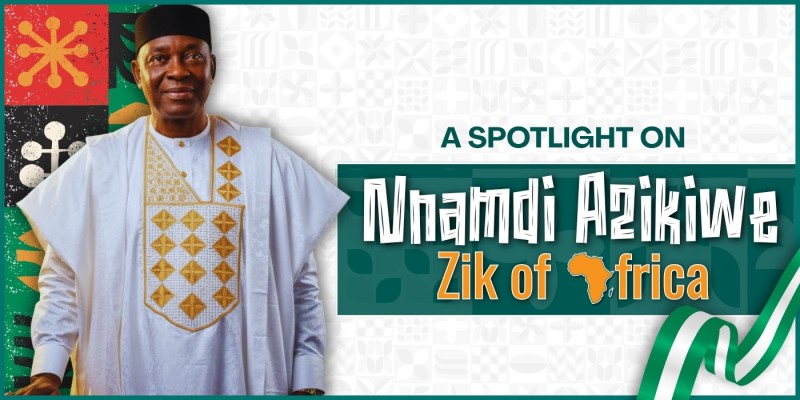
In the pantheon of African liberation leaders, few stars shine as brightly as Dr. Nnamdi Azikiwe. Often affectionately referred to as 'Zik of Africa,' Nnamdi Azikiwe was a journalist, an intellectual, a nationalist and a visionary who fundamentally believed that political independence was just the beginning. His true mission was the creation of a modern Nigeria rooted in shared identity, civic purpose and the indomitable spirit of its people. As we archivally examine his legacy, we delve beyond the public persona to explore the pivotal moments where his faith in the public good dictated action and where his immense responsibilities as a leader collided with the complex realities of a diverse nation.
Early Life and Global Awakening
Nnamdi Azikiwe was born in Zungeru, Niger State, Nigeria, on November 16, 1904. His origins themselves reflected the diversity he would later champion – of Igbo parentage, he was born in the North. His educational journey, spanning multiple continents, was pivotal in shaping his worldview.
While initial schooling occurred in Onitsha, Calabar, and Lagos, Nnamdi Azikiwe’s true intellectual awakening began when he traveled to the United States in 1925. This was an era marked by the vibrant intellectual discussions of the Harlem Renaissance and the rising tide of Black consciousness. Over nearly a decade, he attended Storer College, Lincoln University (Pennsylvania), Howard University, and the University of Pennsylvania, accumulating degrees in political science and anthropology.
It was during this time that he absorbed the philosophies of Pan-African champions like Marcus Garvey and WEB Du Bois. Their writings, advocating for the unity, dignity, and political sovereignty of people of African descent worldwide, ignited a fire within him. He witnessed firsthand the impact of systemic racism in America, which only solidified his resolve to fight against colonialism. Crucially, he also learned the power of the written word as a tool for mobilisation and change.
Journalism as a Liberation Strategy
Returning to Africa in 1934, Azikiwe did not immediately enter politics. Instead, he chose journalism as his vehicle for crafting a national consciousness. He first worked in Ghana (then the Gold Coast) as editor of the African Morning Post. Here, his anti-colonial editorials quickly drew the ire of the British authorities, leading to his deportation back to Nigeria.
Undaunted, Azikiwe founded the West African Pilot in Lagos in 1937. This was a potent platform that directly challenged British colonial rule and championed the cause of Nigerian independence. The Pilot’s mantra, "Show the light and the people will find the way," resonated deeply with the burgeoning Nigerian intelligentsia and the nascent working class alike.
He used the press not just to critique the colonial masters, but critically, to imagine a post-colonial Nigeria. His writings focused on building a sense of "mental emancipation", encouraging Africans to take pride in their heritage and believe in their capability to govern themselves. By the 1940s, Zik and the West African Pilot had become synonymous with Nigerian nationalism.
The Pivot to Politics and the Struggle for Unity
Zik’s journalism paved the way for his active entry into the political arena. In 1944, he, alongside the legendary Herbert Macaulay, co-founded the National Council of Nigeria and the Cameroons (NCNC). As general secretary (and later president after Macaulay's death), Azikiwe toured Nigeria extensively, using his formidable oratory skills to unite diverse ethnic groups under the banner of a single nationalist movement.
This period, however, also highlighted the challenges of leadership in a pluralistic society. As Nigeria moved closer to independence, pre-existing ethnic divisions were often exploited and intensified. While the NCNC aimed to be a national party, its support base was primarily strong in the East and Lagos. The emerging Action Group (AG) in the West and the Northern People’s Congress (NPC) in the North created a political landscape fractured along regional and ethnic lines.
This was "The Leader's Dilemma" personified. Azikiwe deeply believed in Nigerian unity, yet he found himself navigating a system where ethnic allegiances were powerful. He faced the difficult task of balancing his nationalistic ideals with the pragmatic need to secure support within this divided landscape. His faith in the public good was tested as he strived to find common ground amidst the emerging regional rivalries.
Steps to Power and National Governance
Despite these challenges, Azikiwe's political influence grew. He held various positions as Nigeria navigated constitutional changes toward self-rule. He served as the Premier of the Eastern Region from 1954 to 1959.
Following the pivotal 1959 federal elections, where no single party won an outright majority, Nigeria moved toward independence with a complex political arrangement. In a crucial compromise designed to stabilize the new nation, the NPC (Northern based) and the NCNC (primarily East based) formed a coalition government.
This compromise came with significant personal decisions for Azikiwe. While Alhaji Sir Abubakar Tafawa Balewa of the NPC became Nigeria’s first Prime Minister, Azikiwe assumed the ceremonial, yet highly symbolic, role of the first indigenous Governor-General in 1960. He held this position until 1963 when Nigeria became a Republic.