Edward Francis Small
Feb 21, 2026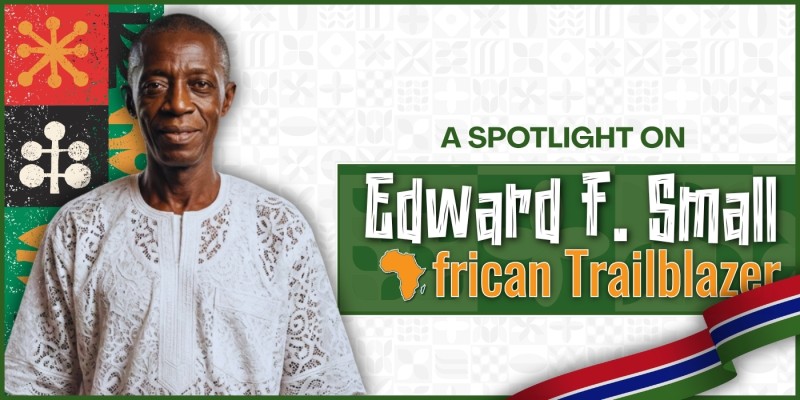
In the chronicles of African liberation, few figures embody the spirit of "Mental Emancipation" and organised resistance as purely as Edward Francis Small. Known as the "Father of Gambian Politics," Small was a journalist, a labour leader and a defiant Pan-Africanist who understood that the path to sovereignty was paved through the collective power of the working class. His mission went beyond mere reform; he sought a radical reimagining of the African identity - one that demanded "No Taxation Without Representation." As we examine his legacy, we look past the colonial records to find a leader whose unwavering commitment to the public good laid the foundation for a modern, self-determined Gambia.
Early Life and the Spark of Activism
Edward Francis Small was born in Bathurst (now Banjul), The Gambia, on January 29, 1891. Descended from the Aku community, a group with deep intellectual and pan-regional ties, Small was born into a culture of social awareness. His education in The Gambia and Sierra Leone was rigorous, but it was his early professional life that truly sharpened his political edge.
While his initial career began in the clergy and as a teacher, Small’s true awakening occurred during his time as a mission agent in the rural districts of the Gambia. There, he witnessed the stark exploitation of farmers by colonial trading companies. This firsthand exposure to economic injustice ignited a fire within him, leading him to abandon the pulpit for the platform of political activism.
It was during this formative period that he began to cultivate the "Visionary Direction" necessary for nation-building. He realised that the colonial system thrived on the isolation of the African voice, and he resolved to build a unified front that could challenge the empire’s economic stranglehold.
Journalism and Labour as Revolutionary Tools
Returning to Bathurst after a brief exile in Senegal, Small did not wait for the colonial authorities to grant him a seat at the table; he built his own. In 1922, he founded The Gambia Outlook and Senegambia Reporter. Like Zik of Nigeria, Small used the press as a vehicle for "Mental Emancipation," using his editorials to dismantle the myth of colonial benevolence and encourage Gambians to take pride in their capacity for self-rule.
However, Small understood that the written word must be backed by organised action. In 1929, he organised the first majour labor strike in Gambian history through the Bathurst Trade Union. For nearly 62 days, he led a disciplined movement that brought the colonial economy to a standstill. This was "Institutional Integrity" in its rawest form, building a system of collective bargaining that was stronger than the individual threats of the colonial administration.
He used these platforms to link Gambian struggles with the broader Pan-African movement. As a founding member of the National Congress of British West Africa (NCBWA), he worked alongside leaders across the region to demand that Africans have a decisive say in their own governance.
The Leader’s Dilemma and the Struggle for Representation
Small’s transition into formal politics was marked by the persistent dilemma. He operated in a colony where the British sought to maintain control through "Indirect Rule," often trying to co-opt local voices. Small faced the difficult task of participating in colonial councils while remaining an uncompromising advocate for total independence.
He deeply believed in the "Healer" role of leadership, striving to unite the urban intelligentsia of Bathurst with the marginalised farmers of the protectorate. He faced the challenge of balancing these diverse interests against a colonial administration that was expert at the "divide and rule" tactic. His faith in the public good remained his "Moral Compass," even when he stood as a solitary voice of dissent in the Legislative Council.
Steps to Power and the Legacy of Sovereignty
Despite the constant surveillance and pressure from the British authorities, Small’s influence was undeniable. He served as the first Gambian to be elected to the Legislative Council in 1947, a milestone that signaled the beginning of the end for colonial rule.
His compromise was never one of principle, but of strategy. He focused on the "Pillar of Economic Strategy," founding the Gambia Farmers' Co-operative Association to give indigenous producers the leverage they needed to survive. He proved that sovereignty is not just a flag or an anthem; it is the ability of a people to control their own land, labor, and capital.
Edward Francis Small’s legacy is the blueprint for the Superpower Africa by 2050 mandate. He was the "Institutionalist" who taught us that power is built through organisation, and the "Diplomat" who saw the Gambia’s struggle as part of a global African family. His life reminds us that the architecture of a nation begins with the courage to demand representation and the integrity to serve the people above all else.