Ellen Johnson Sirleaf
Mar 28, 2026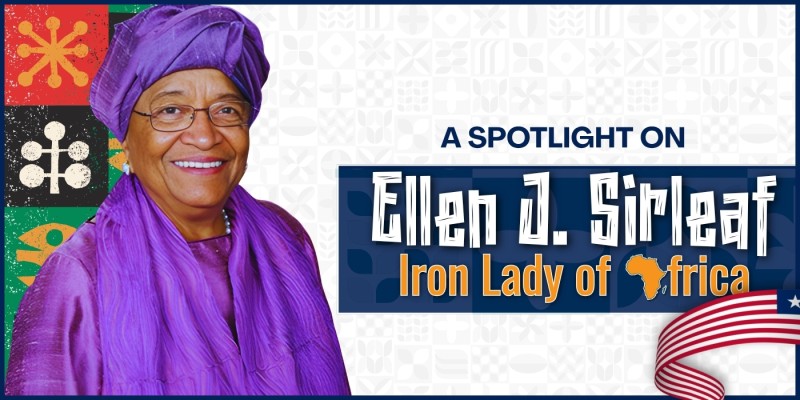
In the vast landscape of African leadership, Ellen Johnson Sirleaf stands as a singular force of resilience and institutional renewal. Often hailed as Africa’s "Iron Lady," Sirleaf is more than just a politician; she is a reformer, a technocrat and a visionary who believes that a nation’s reconstruction must begin with the empowerment of its people and the restoration of its moral fabric. Her mission goes beyond simply ending Liberia’s long night of conflict; it is the meticulous rebuilding of a state rooted in transparency, gender equity and the rule of law. As we examine her legacy, we explore the pivotal moments where her conviction in democratic governance collided with the immense challenges of a nation recovering from the brink of collapse.
Early Life and Intellectual Foundation
Ellen Johnson was born in Monrovia, Liberia, on October 29, 1938. Her heritage was a microcosm of the Liberian experience, descended from both indigenous Gola and German-settler lineages, she possessed a unique vantage point on the social stratifications of her country. Her educational journey was marked by a relentless pursuit of excellence that eventually took her across the Atlantic.
While her initial studies took place at the College of West Africa in Monrovia, her professional trajectory was shaped by her time in the United States. During the 1960s and 70s, she attended Madison Business College, the University of Colorado, and finally Harvard University, where she earned a Master of Public Administration. This period equipped her with the fiscal and administrative rigor that would later become her trademark in governance.
It was during these years that she absorbed the complexities of global finance and development. Witnessing the disparity between Liberia’s vast natural wealth and its systemic poverty, she developed a resolve to apply high-level economic strategy to national liberation. She understood early on that without sound financial institutions, political sovereignty would always remain fragile.
Technocracy as a Tool for Reform
Returning to Liberia, Sirleaf did not initially seek the presidency. Instead, she entered the engine room of the state, serving as Assistant Minister of Finance and later as the first female Minister of Finance in 1979. In these roles, her commitment to fiscal discipline and her refusal to overlook corruption quickly brought her into conflict with the established political order.
Following the 1980 military coup, Sirleaf chose a path of principled opposition. Her outspokenness led to multiple imprisonments and eventually forced her into exile. During this time, she worked for international bodies like the World Bank and the United Nations Development Programme (UNDP). These roles were not merely professional detours; they were strategic opportunities to build the global alliances and "Strategic Sovereignty" she would later need to navigate Liberia’s debt crisis.
She used her platform in exile to maintain a "Mental Emancipation" for her people, constantly advocating for a return to democratic norms. By the time the civil wars subsided, Sirleaf had become synonymous with the hope for a technocratic and ethical rebirth of the Liberian state.
The Pivot to Leadership and the Burden of Peace
Sirleaf’s transition from an international economist to the leader of a war-torn nation was a definitive moment in African history. In 2005, she made history as the first elected female head of state in Africa. Her victory was a mandate for change, but it also presented a profound "Leader’s Dilemma."
She inherited a nation with a shattered infrastructure, a demoralised civil service and a staggering $4.9 billion foreign debt. Her task was to heal a deeply divided society while simultaneously enforcing the "Rule of Law" over the "Rule of Man." She faced the difficult challenge of balancing the need for justice with the pragmatic requirements of stability and reconciliation. Her faith in the public good was tested daily as she navigated the complex transition from a culture of conflict to one of constitutional order.
Steps to Power and the Architecture of 2050
Despite the immense pressures, Sirleaf’s influence grew through her results-oriented governance. During her two terms as President (2006–2018), she successfully negotiated the total cancellation of Liberia’s external debt and oversaw a period of significant economic growth and institutional strengthening.
Her compromise was often one of patience and persistence. She focused on the "Pillar of Institutional Integrity," ensuring that the country’s recovery was not dependent on her personality, but on the strength of its systems. Her leadership earned her the Nobel Peace Prize in 2011, recognizing her efforts to further women's rights and her role in the "Healer" capacity of nation-building.
Ellen Johnson Sirleaf’s legacy reminds us that leadership is a mandate of service. As we architect the path toward a Superpower Africa by 2050, her life serves as the blueprint for the "Moralist" and the "Institutionalist," proving that with integrity and strategic vision, a nation can indeed rise from the ashes to reclaim its place on the global stage.